On a spring day in 1929, Helen Cordelia Kewin ran out of her house, screaming at a motorcycle riding by to quit making so much noise.
She had just put down her fourteen-month-old baby to sleep, and he desperately needed his rest.
Little baby Jack was dying, and Cordelia knew it.
Cordelia’s daughter, Mona, just shy of six years old at the time, had never seen her mother upset like this. It was such unusual behavior for her mother, in fact, that young Mona knew something was very, very wrong.
Cordelia was simply “beside herself,” as Mona described it, watching her baby die.1
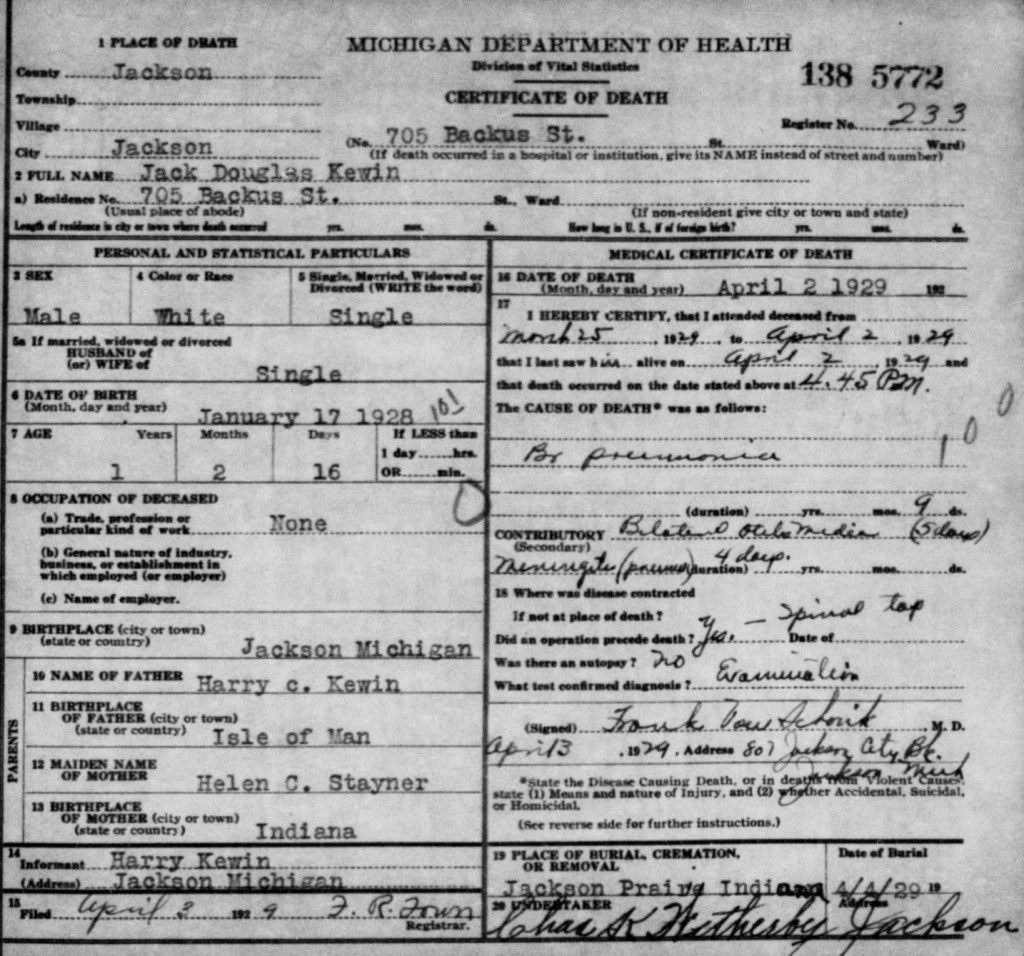
Jack Douglas Kewin, a beautiful baby boy, fell ill in March 1929. He was so sick he even needed a spinal tap in his final days as the doctor assessed his illnesses.
Baby Jack passed away on April 2, 1929, due to bronchial pneumonia after suffering from a double ear infection for five days and meningitis for four days.
He died at home.
I have always felt curiously connected to Cordelia Kewin, since the early days of my family history research. I can’t explain it, but it has always been so.
Maybe it’s because I loved my Grandma Mona so much, how could I not love her mother, too?
Or maybe it’s because Grandma told me that I reminded her of Cordelia, and that made me feel special.
Regardless of the reason, I have spent a lot of time researching and learning about Cordelia’s life as a result of that connection.
I heard the story about Cordelia and baby Jack many times over the years in conversations with Grandma Mona, the first time before I was even married, let alone a mother.
Each time I heard it, I felt keenly emotional and often brought to tears, imagining my great-grandmother running out the door, yelling at the motorcyclist to be quiet, as her dying baby slept.
Once, a few years before Grandma Mona passed away, we drove to the house at 705 Backus St. in Jackson where she lost her little brother. By that time, I was well into motherhood myself and the thought of Cordelia feeling such panicked helplessness to save her baby overwhelmed me.
It was just so sad. Too sad. The type of sadness that simply shouldn’t exist.
I wish I could give Cordelia a hug and whisper, “I know how much you love him.”
In the midst of dealing with the loss of her child and its accompanying grief, Cordelia’s health slowly declined from the effects of active tuberculosis.
After a year or two at home in bed, Cordelia required professional care. On November 13, 1931, she was one of the earliest patients admitted in the Jackson County Sanatorium, which opened in January that year.3
I suspect Cordelia’s greatest wish was to be at home, a partner to her devoted husband, Harry, and a mother to her children. Tuberculosis robbed many people of such dreams.
One child had already been taken away from her, and now she was taken away from her living children. What a nightmare that would have been.
While in the TB san, Cordelia kept a little diary, the type that had room for a few lines per day.
Most of her entries mentioned the weather, when Harry or the children or friends and family came to visit, tests and treatments and results, other patients, how she felt, reminders, and the like.
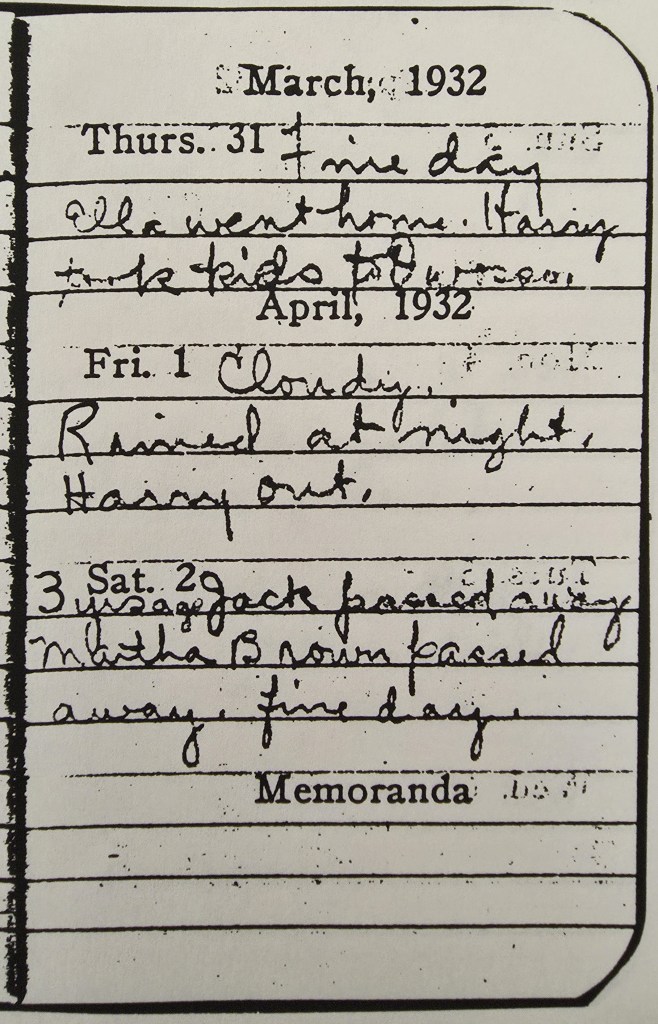
A few years ago, I reread my copy of her diary as I prepared material for an upcoming presentation on tuberculosis and TB sanitoriums. I wanted to include the patient’s point of view and hoped her diary would help me understand her world during that year in the san.
I closely read each entry, searching for details about her life, and this time around I caught many things I hadn’t noticed before.
When I reached the entry for April 2, I stopped and gasped out loud.
And then I sobbed.
“3 yrs. ago Jack passed away.”
Cordelia, quite literally fighting for her life at the TB san, remembered the life of the little one she buried just three years before.
She could not know that April day in 1932 that her visits with her living children, Kathleen, Mona, and Ramsey, would stop within the next three months due to her declining health.
She could not know that she would never go home; that she would leave this world behind on December 17, 1932, and in the process, leave her husband and living children as well.
She could not know any of these things, but she knew she was ill. She must have known the grim statistics of tuberculosis. And she knew she was fighting to live.
In the midst of all this, the illness, the suffering, the worry and fear, she remembered him. She remembered her little one, the baby she put to sleep as he lay dying.
She remembered him, trapped in that hospital room, day after day, as she lay slowly dying.
She remembered her son.
He was on her mind, and always would be, no matter what.
Like Cordelia, I know what it is to lose a child.
At the time I read this entry, I had lost my own son just a few months prior. He was a young adult at the time, but he was still my baby.
He is always on my mind, and always will be, no matter what.
I know what it is to live with heartache and sorrow, pain and desperation, the agony of loss and to hurt so bad I can’t breathe.
I know what it is to explode with panicked helplessness, to feel beside myself with grief.
I know what it is to have the urge to run out the door screaming, yelling at the world to stop moving so fast and quit making so much noise.
Doesn’t the world know my baby, my son, is dead?
I know all these things, and I suspect Cordelia knew them, too.
And just like Cordelia, who remembered her son as she suffered through the lingering death that was tuberculosis, I will remember my son no matter what I may face in my future.
It matters not, good or bad, what is in store for me, what paths my future might take.
I will remember my son.
Sitting on my bed that night, reading the entry in Cordelia’s diary from April 2, 1932, tears streaming down my face, sobs shaking me from head to toe, I felt connected to Cordelia in a way I can’t explain.
Mother to mother. Great-grandmother to great-granddaughter. Bereaved mothers.
I cried and cried and cried until I couldn’t cry anymore.
In my imagination, Cordelia weeps with me as she wraps her arms around me and whispers,
“I know how much you love him.”
- Mona Hilden-Beckwith told me the story of her mother, Helen Cordelia Kewin running outside, several times over the years. She specifically remembered Jack as a “beautiful baby.” One retelling is captured in an interview between Mona Hilden-Beckwith and the author in June 1997. Cassette recording and transcription of the interview in possession of the author. ↩︎
- Information about Jack Douglas Kewin’s illnesses and death, including location, found in his official death certificate. See Death Certificates 1897-1952, Michiganology (www.michiganology.com : accessed 16 July 2025) > Michiganology.org > Advanced Search > Death Certificates 1897-1952 > search terms first name (Jack Douglas), last name (Kewin). ↩︎
- Patients from the old tuberculosis hospital were relocated to the new Jackson County Sanitorium on 6 January 1931. Originally designed for 54 patients, 110 patients were admitted in 1931. See “Sanitoriums treated ‘tuberculosis patients,'” Susanne Weible, MLive (www.mlive.com/citpat_history/2009/01/sanatoriums_treated_tuberculos.html : accessed 16 July 2025). ↩︎
- Image taken from the 1932 diary of Helen Cordelia Kewin; page including entries for 31 March 1932 through 2 April 1932. Reference to Jack Kewin’s passing included in entry dated 2 April 1932. Copy of diary in possession of author. Cordelia’s diary includes references to her length of stay at the TB san, which indicates she was admitted on November 13, 1931. She often mentioned the passing of friends, family, and acquaintances, but those were recorded at the time of the event, whereas her entry for Jack was a note about a past event. She also recorded days when her children came to visit. On June 19, she wrote, “Harry here. Did not see family.” Then on June 23, she wrote, “Mona’s birthday. Had party.” It is unclear if the party happened at the TB san or elsewhere. There are no entries about seeing the children after June 23. Grandma Mona mentioned to me in conversation that she did not see her mother after June or July of that year, which correlates with the lack of entries about seeing the children after that time. ↩︎
 Serendipity and Family History